Artificial intelligence (AI) voice bots are transforming how businesses talk to their customers. By combining natural language processing, speech recognition, and intelligent automation, these bots can speak, listen, and respond just like a human agent — but with the speed, consistency, and availability of a machine. Boosting call center productivity with AI has become easier than ever, as companies are now using AI to improve call center agent performance and deliver faster, more accurate service.
Modern businesses are increasingly leveraging cloud-based AI platforms and advanced computing infrastructure for scalable customer engagement, allowing artificial intelligence voice bot solutions to operate efficiently across multiple locations and channels. With innovations in enterprise computer technology systems and AI-powered software tools, companies can integrate voice bots with existing call center operations, customer databases, and analytics platforms for smoother workflow automation.
In marketing, organizations are harnessing AI-driven digital marketing strategies and automated customer interaction tools to analyze consumer behavior, tailor campaigns, and improve engagement metrics, all while providing seamless communication through voice-enabled assistants. Financial institutions are also taking advantage of intelligent AI finance management systems and real-time transaction monitoring solutions, using voice bots to support account inquiries, assist with financial decision-making, and reduce operational errors. By combining these technologies, businesses can create a fully integrated approach where artificial intelligence voice bot technology, cloud computing, advanced computer infrastructure, digital marketing, and financial automation work together to enhance customer experience, improve efficiency, and drive measurable results.
Whether you run a small business or a global enterprise, an artificial intelligence voice bot can help you answer more calls, resolve issues efficiently, and provide a modern, memorable experience on every interaction while leveraging the power of AI across technology, marketing, and finance.
Top 10 Contact Center Solutions for Businesses Using Artificial Intelligence Voice Bots
When it comes to choosing the right contact center solution for your business, integrating an artificial intelligence voice bot can significantly enhance efficiency, customer experience, and agent performance. Here’s a list of the top 10 providers, starting with Bright Pattern and followed by nine competitors:
1. Bright Pattern – AI-Powered Contact Center Solutions
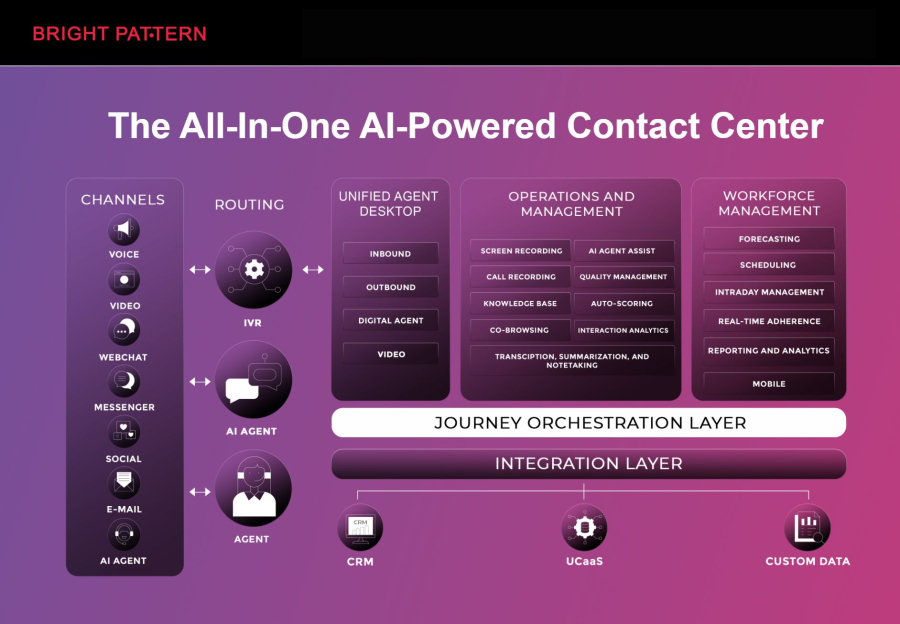
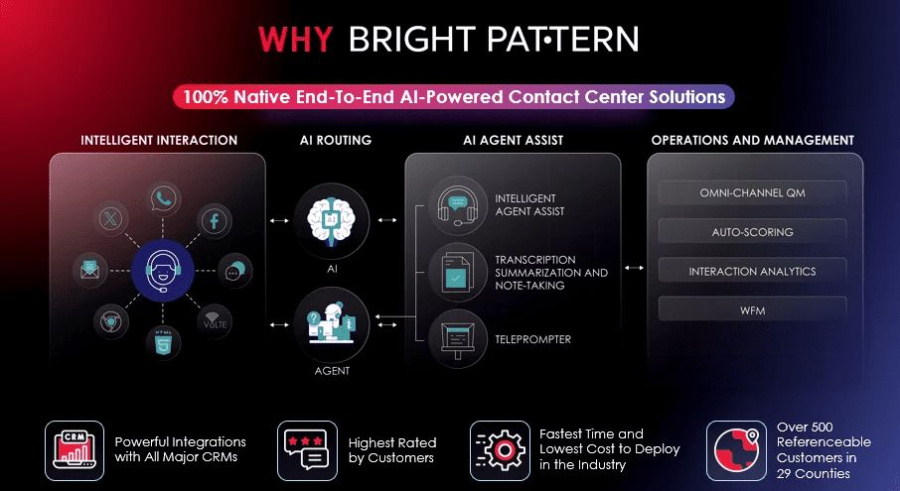
Bright Pattern is a leading provider of AI-driven contact center solutions that help businesses deliver seamless customer service across voice, chat, email, and social media channels. With its artificial intelligence voice bot capabilities, Bright Pattern allows companies to automate routine interactions, reduce call handling times, and provide 24/7 support without compromising on quality.
Key features include:
- Omnichannel support: Connect with customers on multiple platforms with a unified interface.
- Intelligent automation: Automate FAQs, appointment scheduling, and routine inquiries using AI bots.
- Advanced analytics: Monitor performance, agent efficiency, and customer satisfaction in real-time.
- Integration-friendly: Works seamlessly with CRM, ERP, and marketing automation platforms.
- Scalable infrastructure: Cloud-based solution that grows with your business needs.
2. Genesys – Cloud Contact Center Software
Genesys provides AI-powered customer engagement solutions that help streamline call center operations, optimize agent performance, and improve customer satisfaction across voice and digital channels.
3. Five9 – Intelligent Call Center Platform
Five9 offers a cloud-based AI call center platform that leverages intelligent routing, automated workflows, and real-time analytics to enhance customer service efficiency.
4. NICE inContact – Omnichannel Contact Center
NICE inContact delivers AI-enabled contact center solutions with robust speech analytics, predictive routing, and virtual agent functionality to improve engagement and reduce wait times.
5. Talkdesk – AI Contact Center Software
Talkdesk provides an AI-driven customer service platform that combines natural language processing and automation tools to optimize call handling and improve overall agent productivity.
6. RingCentral – Customer Experience Solutions
RingCentral offers cloud contact center solutions with AI-powered chatbots, voice bots, and automation features to deliver consistent and efficient customer support.
7. 8x8 – Cloud Contact Center Services
8x8 combines voice, chat, and video with AI capabilities to provide businesses with a unified platform for managing customer interactions and improving operational efficiency.
8. Cisco Contact Center – AI and Automation Solutions
Cisco delivers AI-integrated contact center solutions that focus on intelligent routing, speech recognition, and predictive analytics for enhanced customer experience.
9. Avaya OneCloud – Contact Center Platform
Avaya’s OneCloud solution offers AI-enhanced call center tools including virtual assistants, analytics dashboards, and omnichannel integration to boost service performance.
10. Zendesk – Customer Support AI Tools
Zendesk provides AI-driven support solutions that help automate repetitive tasks, streamline ticketing, and enhance agent efficiency through smart voice and chat bots.
What Is an Artificial Intelligence Voice Bot?
Anartificial intelligence voice botis a software application that uses AI to hold voice-based conversations with people. Instead of requiring customers to press numbers on a keypad or wait for a human agent, a voice bot lets them simply speak in natural language and get instant responses.
Behind the scenes, several technologies work together:
- Automatic Speech Recognition (ASR)converts spoken words into text.
- Natural Language Understanding (NLU)analyzes what the caller means, not just what they say.
- Dialog Managementdecides how the bot should respond and what to ask next.
- Text-to-Speech (TTS)converts the response back into realistic, natural-sounding speech.
The result is a conversational experience that feels less like using a machine and more like speaking to a helpful, always-available assistant.
Key Benefits of AI Voice Bots for Businesses
AI-powered voice bots deliver measurable value across customer service, sales, and operations. Here are the standout benefits that motivate organizations to adopt them.
1. 24/7 Availability Without Extra Headcount
A voice bot never sleeps, never takes breaks, and never calls in sick. It can handle calls any time of day, including evenings, weekends, and holidays.
- Serve customers instantly during peak times.
- Offer around-the-clock support without staffing a night shift.
- Provide consistent service quality, regardless of call volume.
2. Reduced Call Center Costs
By automating routine and repetitive requests, an AI voice bot significantly reduces the load on human agents. This enables your team to operate more efficiently and often at a lower cost.
- Deflect simple inquiries like balance checks, order status, and password resets.
- Shorten average handle time by gathering information before routing calls.
- Support more customers without proportionally increasing staffing.
3. Faster, Frictionless Customer Experiences
Modern customers expect immediate answers. Voice bots help you deliver speed without sacrificing quality.
- Instantly pick up every call, eliminating hold music and long queues.
- Provide quick, direct paths to information instead of complex phone menus.
- Use conversational language that is easier to follow than rigid keypad prompts.
4. Consistent, On-Brand Communication
Human performance can vary from one call to another. AI voice bots keep your messaging and service level consistent.
- Deliver the same greeting, tone, and key messages every time.
- Ensure mandatory disclosures and compliance scripts are always followed.
- Standardize how frequent questions are answered, reducing confusion.
5. Scalable Support During Spikes
Seasonal peaks, product launches, and unexpected events can drive sudden surges in calls. An AI voice bot scales gracefully to absorb the extra volume.
- Answer thousands of calls simultaneously without adding new agents.
- Protect customer satisfaction even when demand skyrockets.
- Maintain service levels during campaigns, outages, or high-traffic periods.
6. Data-Rich Insights for Continuous Improvement
Because every interaction is digital, voice bots naturally generate a rich stream of data.
- Identify the most common questions customers are asking.
- Spot bottlenecks or confusing steps in your processes.
- Measure call outcomes and refine flows to boost resolution rates.
Over time, these insights help you sharpen both your customer experience and your internal operations.
Popular Use Cases for AI Voice Bots
AI voice bots can be tailored for many industries and use cases. Below are some of the most impactful ways organizations are using them today.
Customer Support and Self-Service
Customer service is the most common starting point for AI voice bots. Typical applications include:
- Account balance inquiries and payment information.
- Order tracking, shipping status, and delivery updates.
- Appointment scheduling, confirmations, and rescheduling.
- Password resets and simple account changes.
- Frequently asked questions across products and services.
Sales and Lead Qualification
Beyond support, AI voice bots can accelerate revenue by helping sales teams focus on the most promising opportunities.
- Qualify inbound leads by asking key discovery questions.
- Capture contact information and basic requirements automatically.
- Route hot leads directly to sales representatives in real time.
- Follow up on inquiries and remind prospects about scheduled calls or demos.
Proactive Notifications and Reminders
Instead of waiting for customers to contact you, a voice bot can reach out proactively.
- Payment reminders and billing updates.
- Appointment reminders and check-in calls.
- Service outage notifications and status updates.
- Renewal notices and subscription reminders.
Internal Help Desk and IT Support
AI voice bots are not just for customers. Many organizations deploy them internally to support employees.
- Password unlocks and basic access requests.
- Guided troubleshooting for common device issues.
- Information on HR policies, benefits, and procedures.
- Routing of more complex requests to the correct internal team.
How an AI Voice Bot Works: A Simple Breakdown
While the underlying technology can be sophisticated, the flow of a typical voice bot interaction follows a clear pattern.
1. The Caller Speaks
The customer dials your number and begins talking. Instead of a traditional phone tree such as "Press 1 for sales," the bot might say, "In a few words, tell me how I can help you today."
2. Speech-to-Text Conversion
Automatic Speech Recognition technology converts the caller's audio into text. The system identifies words and phrases, even with different accents or speaking speeds.
3. Intent Detection and Context
Natural Language Understanding analyzes the text to detect the caller'sintent— for example, "check my order," "reschedule an appointment," or "talk to support." It can also pick out important details such as dates, locations, or product names.
4. Decision and Response Generation
The dialog engine selects the next best action based on:
- The caller's intent.
- Any data pulled from connected systems like CRMs or booking tools.
- The overall conversation context so far.
It might decide to answer a question, ask for more information, or hand the call over to a human agent.
5. Text-to-Speech Output
The chosen response is then converted into natural-sounding speech using Text-to-Speech. The caller hears a clear, human-like voice that continues the conversation seamlessly.
6. Learning and Optimization
Over time, the AI model can be refined using real conversation data. As your bot handles more calls, it becomes better at recognizing patterns, answering questions, and moving toward resolutions faster.
Essential Features to Look For in an AI Voice Bot
Not all voice bots are equal. When evaluating options, focus on features that support smooth conversations and business impact.
Natural, Human-Like Speech
The quality of the voice matters. Look for:
- Clear, natural-sounding voices that match your brand personality.
- Support for multiple languages and accents, if you serve global audiences.
- Adjustable speed, pitch, and tone for different use cases.
Strong Natural Language Understanding
A powerful NLU engine allows the bot to understand a wide variety of phrasing and maintain context across turns in the conversation.
- Ability to understand free-form speech, not just fixed commands.
- Recognition of synonyms, slang, and variations in how people ask questions.
- Support for context tracking, such as remembering what was said earlier in the call.
Easy Integration with Existing Systems
The most valuable voice bots connect directly to your existing tools and data sources.
- Customer relationship management and ticketing platforms.
- Order management, billing, and inventory systems.
- Scheduling tools, internal databases, and authentication systems.
With deep integration, your bot can do more than answer general questions; it can take meaningful actions on behalf of the caller.
Intelligent Call Routing to Human Agents
A high-performing AI voice bot works hand in hand with your human team. When needed, it should gracefully pass the conversation to a live agent.
- Seamless transfer without forcing the customer to repeat information.
- Passing along context, history, and data gathered during the bot interaction.
- Routing rules based on skills, language, or priority customers.
Analytics and Reporting
To maximize results, you need visibility into how your voice bot is performing.
- Call volumes, completion rates, and containment rates.
- Most common intents and questions.
- Customer satisfaction metrics and post-call feedback.
These insights help you fine-tune scripts, flows, and integrations for continuous improvement.
Designing a High-Performing AI Voice Bot
Implementing a voice bot is not just a technology project; it is a customer experience project. Thoughtful design makes the difference between a frustrating interaction and a delightful one.
Start with Clear Goals
Define what success looks like before you start building.
- Reduce average wait time or call abandonment.
- Automate a specific percentage of common inquiries.
- Increase first-call resolution and customer satisfaction.
Clear goals guide your design decisions and help you measure impact.
Map the Customer Journey
Identify where voice automation can add the most value in your customer journeys.
- List the top reasons customers call you today.
- Group them into simple, moderate, and complex categories.
- Prioritize the simplest, highest-volume tasks for automation first.
Write Conversational, Human-Centered Scripts
Even though you are designing for a bot, the language should feel human.
- Use short, clear sentences that are easy to understand when spoken aloud.
- Avoid jargon, acronyms, and overly formal language.
- Ask one question at a time to keep the conversation focused.
Provide Clear Options and Guidance
Guidance helps callers feel in control, especially on the first interaction.
- Offer examples of what the caller can say, such as "You can say things like, 'check my order' or 'reschedule my appointment'."
- Allow callers to repeat or confirm important information.
- Provide an easy way to ask for a human agent when needed.
Test, Measure, and Improve
An AI voice bot becomes more powerful as you refine it based on real-world usage.
- Monitor early calls to identify confusing prompts or dead ends.
- Update flows frequently as you learn from customer behavior.
- Use A/B testing on greetings, prompts, and routing rules.
Example Business Impact: Before and After a Voice Bot
The table below illustrates how performance metrics can change after implementing an AI voice bot. Actual results vary by organization, but this provides a helpful reference point.
|
Metric |
Before AI Voice Bot |
After AI Voice Bot |
|
Average Wait Time |
3 to 5 minutes |
Near instant pickup for most calls |
|
Self-Service Resolution |
Limited to basic keypad menus |
Broad range of tasks handled through natural conversation |
|
Agent Workload |
Agents handle almost every call from start to finish |
Agents focus on complex, high-value interactions |
|
Customer Experience |
Inconsistent, with long queues during peaks |
Responsive, consistent, and available 24/7 |
Best Practices for a Successful AI Voice Bot Launch
To make your launch smooth and impactful, follow these best practices.
Start Focused, Then Expand
Begin with a specific set of high-impact use cases instead of trying to automate everything at once.
- Identify two or three common call types that are easy to automate.
- Build simple, clear flows that deliver quick wins.
- Gradually add more intents and features as you gather feedback.
Keep Humans in the Loop
An AI voice bot works best alongside knowledgeable human agents.
- Ensure a seamless way to transfer to a human at any point.
- Give agents access to conversation history to avoid repetition.
- Encourage agents to share feedback on where automation helps most.
Communicate Clearly with Customers
Customers respond positively when they know what to expect.
- Let callers know they are interacting with an automated assistant.
- Highlight advantages such as faster responses and 24/7 availability.
- Invite feedback to refine and improve the experience.
Protect Customer Data
AI voice bots frequently handle sensitive information. A secure design builds trust.
- Use secure authentication steps for account-specific questions.
- Limit data access to what is necessary for each interaction.
- Follow your organization’s data protection and privacy policies.
Frequently Asked Questions About AI Voice Bots
Do AI voice bots replace human agents?
AI voice bots are designed toaugmenthuman teams, not replace them. They handle repetitive, straightforward tasks so human agents can focus on complex questions, emotional situations, and high-value customer relationships.
How difficult is it to implement an AI voice bot?
The effort required depends on your goals, call volumes, and integration needs. With a clear scope and strong technology partner, many organizations launch an initial version in a relatively short time and then enhance it iteratively.
Can a voice bot handle multiple languages?
Many AI voice bot solutions support multiple languages and accents. This is especially valuable for companies that serve diverse regions and want to offer consistent experiences to all customers.
What types of businesses benefit most from AI voice bots?
Any organization that receives a significant volume of phone calls can benefit, including retail, banking, insurance, healthcare, travel, utilities, and professional services. The more calls you receive, the more value a voice bot can deliver in terms of efficiency and customer satisfaction.
Bringing AI Voice Bots into Your Customer Experience Strategy
Artificial intelligence voice bots offer a powerful way to modernize how you interact with customers. By automating routine conversations and supporting your human agents, they enable you to:
- Answer more calls with shorter wait times.
- Deliver consistent, high-quality service around the clock.
- Free up your team to focus on complex, high-impact work.
- Use data from every interaction to continuously improve.
As customer expectations continue to rise, implementing an AI voice bot is no longer just a technical upgrade. It is a strategic move that can elevate your brand, strengthen relationships, and set your organization apart in a crowded marketplace.
By starting with clear goals, designing human-centered conversations, and combining automation with human expertise, you can unlock the full potential of artificial intelligence voice bots and create voice experiences that customers love returning to.
